
Madison Directory Collections by Era
Madison does not have one continuous printed run. Regional volumes, local telephone snapshots, a digitized Huntsville edition, and public census schedules cover different slices of time. The Alabama Department of Archives and History finding aid is the key shelf map. Its Huntsville and Huntsville-Madison County material appears across several boxes, while exact editions must be confirmed with staff.
| Collection | Years represented | Where held | Access |
|---|---|---|---|
| Huntsville directories | 1859-60; 1896; 1929-30; 1955; microfilm 1896-97 and 1908-31; print years through 2002 | Alabama Department of Archives and History | Reference room and finding aid |
| Huntsville-Madison County directories | 1998-99, 1999, 2003, July 2004, July 2005, August 2006 | Alabama Department of Archives and History | Reference room |
| Huntsville Directory Company edition | 1896-97 | Huntsville History Collection | Free PDF |
| Madison Telephone Company | 1944 and 1969 snapshots | Huntsville History Collection | Free articles and images |
| Federal census schedules | Through 1950 | National Archives and genealogy services | Public after 72 years |
These are not interchangeable. The 1896-97 title is Huntsville-focused and cannot be claimed as complete coverage of Madison Station. A notation of “1938-1984” next to one archive box is ambiguous, so it should not be presented as a continuous directory run. Exact year, title, and holding location belong in every citation.
Research Madison Directories In Person
Huntsville-Madison County Public Library's Downtown Special Collections is on the second floor at 915 Monroe Street in Huntsville. Published hours are Monday through Thursday, 9 a.m. to 8 p.m.; Friday and Saturday, 9 a.m. to 5 p.m.; and Sunday, 1 to 5 p.m. The department supports local-history and genealogy work, but its policy requires city-directory research in person. Staff will not answer those directory questions by telephone.
The Downtown library and Special Collections page is the source for the location and access details.
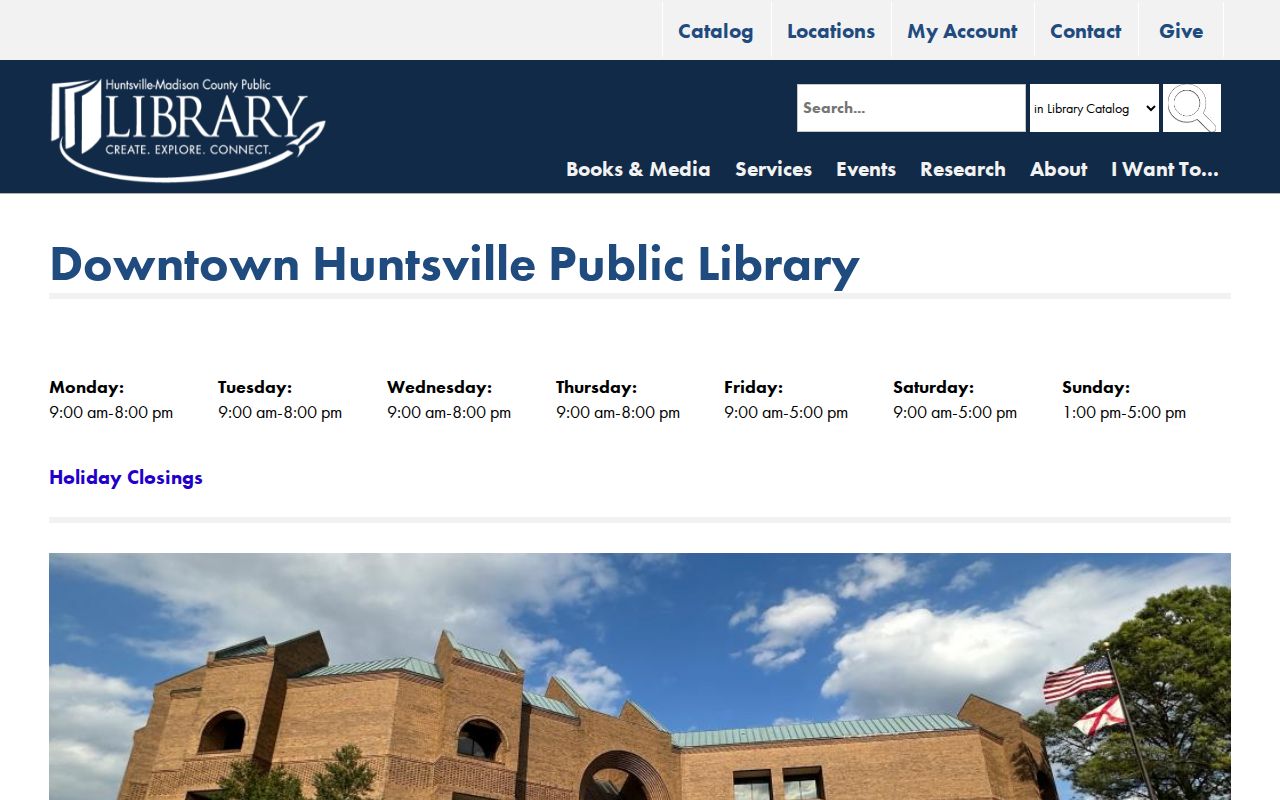
The image identifies the local research destination that fills gaps left by web searches. Call 256-532-5969 for current reading-room details, but plan to inspect the historical volumes at the library rather than request a telephone lookup.
Note: Verify hours and access before travel, since database authentication and reading-room procedures can change independently of the historical holdings.
Decode a Madison Directory Entry
The digitized 1896-97 Huntsville volume shows how one edition structures a line. Entries are surname-first with a given name or initials and sometimes an honorific. They may state an occupation or employer and mark a house or residence. The exact key must be read in the same volume because shorthand can change by publisher and year.
| Identity | Surname, given name or initials, and occasional honorific |
|---|---|
| Work detail | Occupation or employer when printed |
| Address detail | Street number and street, with h for house or r for residence or rooms |
| Observed shorthand | wks, eng, comp, carp, and dep sheriff |
| Edition caution | Do not infer spouse, tenure, or widow status unless that edition explicitly prints it |
Mary Polk appears with a house at 226 Washington. Frank L. Pollard is listed as an engineer at the Ice Factory with a house at 439 W Holmes, and Harvey L. Pollard as a compositor at The Daily Mercury with a house at 532 Spragins. These examples demonstrate fields in the Huntsville volume; they do not prove broad Madison Station coverage.
- Criss-cross directory
- A directory arranged by street and number. No exact Madison year run was verified.
- Householder index
- An index centered on the named person responsible for a listed home, not every household member.
- Abbreviation key
- The edition's own guide to shortened words. Read it before expanding any occupation or residence mark.
Search Madison's Digital Shelves
The HMCPL database catalog names Ancestry Library Edition, MyHeritage Online Genealogy, the Huntsville History Collection, Obituary Index, Valley Digital Library, Huntsville Times archives, and WorldCat. Authentication and present access should be checked with the library. These tools can test a printed-directory find against a census, newspaper, obituary, or cataloged local source without assuming that every database is open from home.
The library's current catalog is shown through the official HMCPL genealogy database listing.
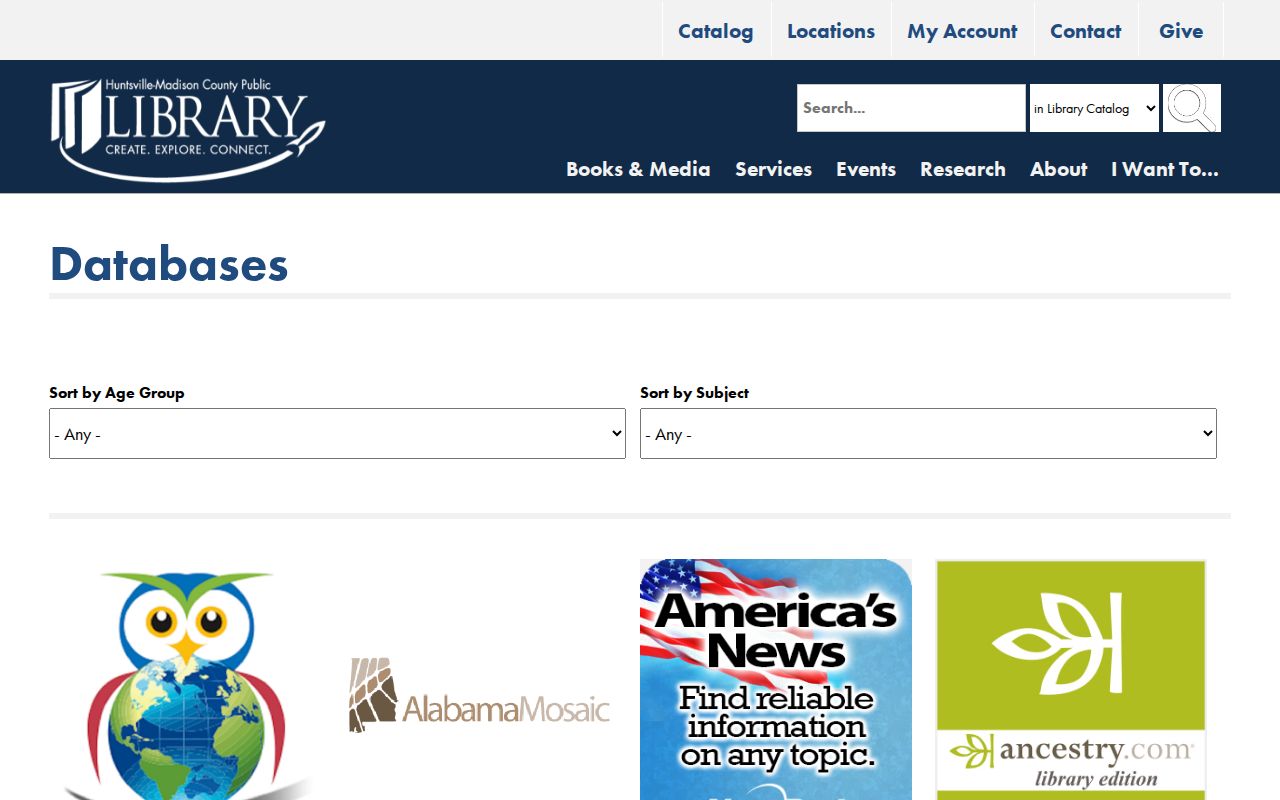
The listed databases widen the search beyond one annual book. An obituary or newspaper item may explain why a person vanishes between editions, while WorldCat can point to a title held outside the local branch.
The Huntsville History Collection adds homes, people, places, and scanned records. Its address-indexed house pages cover Allen, Arnett, Church, College, Front, Main, Maple, Martin, Mill, Short, Sturdivant, and Sullivan streets, making it a particularly local companion to regional directories.
Madison's Handwritten Telephone Directory
The 1944 Madison Telephone Company book is a rare local snapshot. It measured about 3.5 by 6 inches and had eight pages, with four pages devoted to subscribers. Names and businesses were handwritten in alphabetical order beside short numbers. Dr. W. W. Alexander appeared as 30J, Farmers & Merchants Bank as 14, and Hughes Drugstore as 1.
A suffix such as 30J reflects party-line practice, not a modern extension. The list also mixes people, firms, medical offices, and shops. Record the exact spelling, phone number, and edition before linking an entry to a deed, census line, newspaper item, or historic house page. Subscriber does not always mean resident.
This small Madison telephone source has value precisely because it is local. Regional print runs are much larger, but the handwritten book captures the scale and texture of Madison before its space-era growth.
Track Madison Directory Growth
Telephone growth helps explain why early Madison directory evidence is thin and later parcel and subdivision trails are denser. The town had about 500 residents in 1940 and about 1,400 by 1960. Growth tied to Redstone Arsenal and Marshall Space Flight Center accelerated the change, while the city's development moved west from the railroad core.
| Year | Madison directory milestone |
|---|---|
| 1859-60 | Earliest verified Huntsville directory volume in the archive holdings |
| 1896-97 | Huntsville Directory Company edition now available as a free digital PDF |
| 1944 | Eight-page Madison Telephone Company book with handwritten subscriber pages |
| July 10, 1960 | Southern Bell acquired 353 Madison telephones as the 772 exchange began |
| 1969 | Madison telephone book snapshot with four subscriber-list pages |
| 1970 | Telephone count had grown to more than 1,500; party lines persisted into the 1980s |
| 2006 | Latest verified Huntsville-Madison County edition listed in the ADAH holdings |
The sequence is not a claim of continuous annual publication. It is a set of documented points. Missing years remain gaps, and a gap itself can guide the researcher toward census, tax, deed, or newspaper sources.
Place Madison Entries on Streets
Historic Madison Station formed around the railroad. Main, Front, Church, Mill, and Sullivan streets retain strong research value because address-indexed house files can connect a listed name to a known building or lot. The City of Madison incorporated in 1869, but regional volumes begin with Huntsville material and should be read with that geographic limit in mind.
The Madison Station Historic Preservation Society preserves the local district context and welcomes nonmembers at its meetings. The National Register period of significance runs from 1858 to 1950. Local house histories and preservation files can help test whether a directory address belongs to Madison Station rather than to Huntsville.
Street names also shift. Sullivan Street was once Huntsville-Decatur Road. A legal description, subdivision lot, or historic house page can bridge that change when a modern address search fails. The ADAH city-directory finding aid identifies the state archive boxes, but its ambiguous 1938-1984 notation should be checked with staff rather than treated as a continuous run. Current parcel work belongs to the Madison by-street records search, while the historical shelf remains edition-based.
Use Madison Directory Policy
The HMCPL city-directory policy sets a clear access limit: research is conducted in person. That policy is easy to miss when a catalog record appears online. The best preparation is to build a short target list of surnames, spelling variants, dates, and likely streets before arriving.
The policy is documented in the assigned image from the official HMCPL city-directory page.
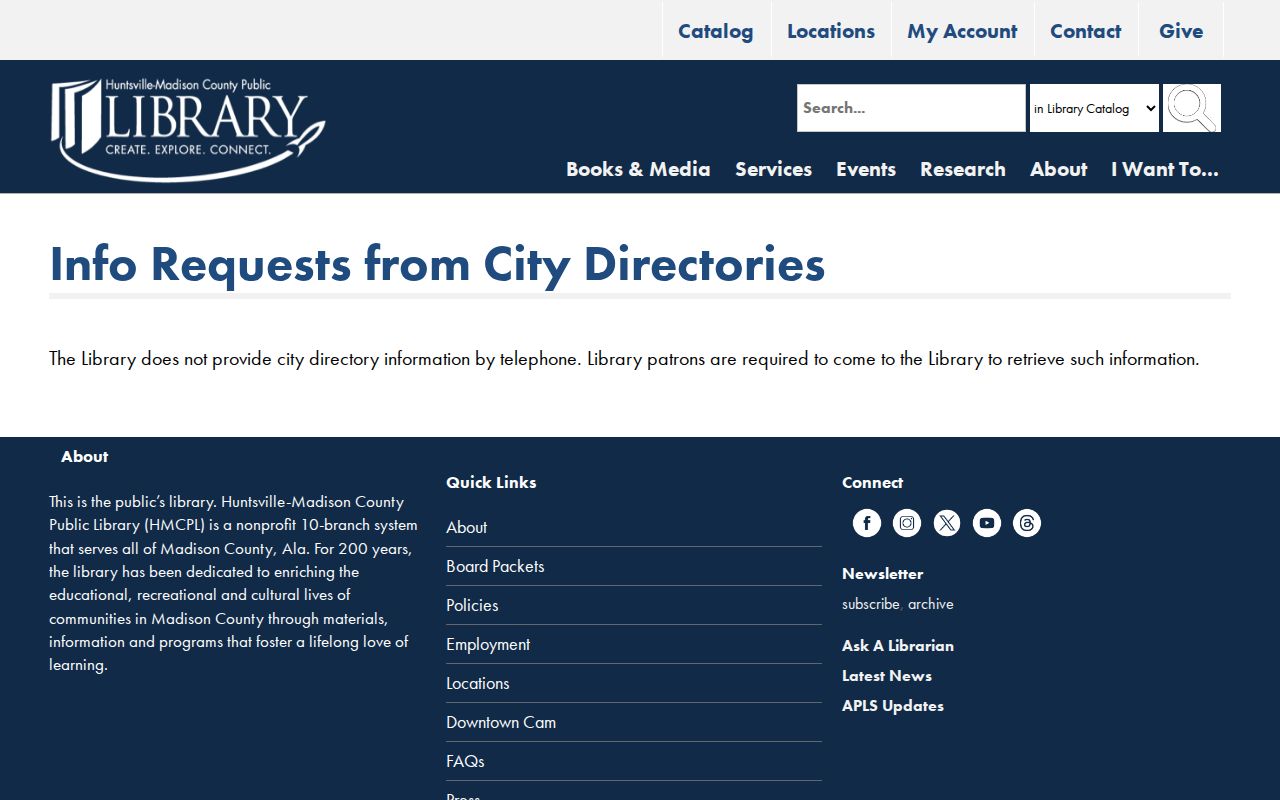
The image supports a practical rule: do not plan a Madison directory search around a phone request. Note call numbers and years in advance, then use the reading room for the actual lookups.
ADAH subject files can add Madison County cemetery, church, club, courthouse, historic-home, town, newspaper, pioneer, Redstone Arsenal, school, and transportation material. Those are companion sources, not substitutes for the dated volumes.
Trace Madison Families Across Directories
A printed directory works best as a dated clue between stronger records. Follow spelling and address changes across the editions that actually exist, then pair each hit with the nearest public census. Federal schedules through 1950 are open under the 72-year rule. The 1960 census is scheduled to open in April 2032, while restricted years remain subject to the Census Bureau's access rules.
- Start with a known surname, approximate year, and Madison or Huntsville-area street. Search spelling variants and initials.
- Copy the full entry and photograph the title page and abbreviation key. Preserve the edition date and publisher.
- Move to the prior and next available editions. Record changes in address, occupation, employer, spelling, and telephone number.
- Pair the result with the nearest open census. Compare age, household relationships, birthplace, and address when those fields exist.
- Test the street in local house files, deeds, newspapers, obituary indexes, and cemetery records. Label any link that remains an inference.
Disappearance from a Madison volume can mean death, a move, a missed edition, a change in listing, or simple omission. An obituary may support death. A deed or later listing may support a move. Silence alone proves none of them.
Note: Historical print is unredacted and date-bound, so cite the precise edition and avoid treating an old entry as a current address.